Youth in Action: My Experience Using GIS to Build Disaster Resilience in Timor-Leste

Dear All, are you as interested in mapping as I am? I am writing this blog as a young woman passionate about using GIS for climate adaptation through disaster mapping and disaster risk reduction. Explore here how GIS has helped me grow and take initiatives in mapping. Hope you enjoy reading this,
JULMIRA DE ALMEIDA
When I first joined G-SIG Timor-Leste two years ago, I never imagined how maps could become a lifeline for communities. For many people, a map is just a tool to show directions or places. But in disaster-prone areas like in a country like Timor-Leste, maps can mean the difference between safety and vulnerability.

Through this blog, I going to write my experience in using GIS for climate change adaptation through disaster mapping in municipality like Bobonaro, Covalima and Manatuto with G-SIG in collaboration with different international agencies in Timor-Leste such as World Vision Timor-Leste, OXFAM in Timor-Leste, PLAN and others. As a young woman passionate about the environment and community resilience, I became involved in Disaster Mapping and Monitoring, focusing on anticipatory mapping for floods and landslides. Through this journey, I have witnessed how technology like GIS is not just about data—it’s about people, preparedness, and saving lives.
Turning Communities into Mappers
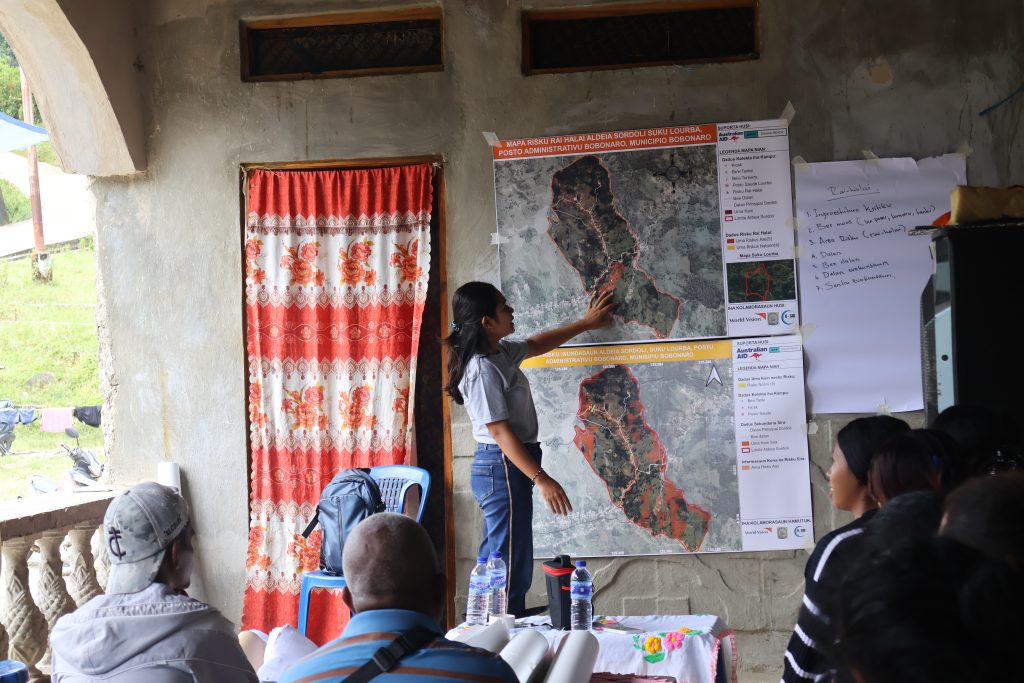
One of the most rewarding parts of my work has been community participatory mapping. Instead of experts working alone, communities themselves are at the center of the process. We sit together with local leaders, youth, and families to identify areas that are most at risk of flooding or landslides. People share their knowledge—where the water usually overflows, which roads become dangerous, and which homes are most vulnerable. By combining this local wisdom with digital mapping tools, we create maps that are accurate, practical, and deeply meaningful to those who use them. I believe this participatory approach not only makes the maps stronger but also builds community ownership of disaster preparedness.

One memory that stands out is in Bobonaro in Suri-Ubu, where a local family pointed out a low-lying area that always floods after heavy rain. This area was not included in any official maps. By including it in our data, we were able to alert the community, and local authorities even planned a small drainage improvement. Seeing people use the map to make decisions gave me a sense of purpose and proof that our work truly saves lives.
From Data Collection to Visualization
My role in G-SIG has covered many steps of the mapping process. I work on data collection, often going into the field to gather information about flood-prone areas, landslide risk zones, and critical community assets such as schools, health centers, and evacuation centers. Once collected, I support data analysis and visualization, transforming raw information into clear, accessible maps. These maps are then shared with communities, local NGOs, and government actors to support better decision-making.

To make this work more dynamic, we use platforms such as Ushahidi, which allows communities to monitor and report disasters in real time, and uMap, which helps visualize data in ways that are easy to understand. For example, during the last rainy season in Bobonaro, communities reported minor floods via Ushahidi. By overlaying these reports on our maps, we identified emerging risk zones and communicated alerts promptly.
Building Capacity through Training
Technology is only as strong as the people who use it. That’s why another major part of my journey has been facilitating training sessions. I have led workshops in several municipalities, including Oecusse and Bobonaro, where I worked closely with community members and local NGOs.
These training sessions focus on teaching people how to:
During one training in Bobonaro, a group of young women, local authority and youth from their village who had never used GIS before were able, within a few hours, to map vulnerable households in their village. Watching their confidence grow as they realized they could contribute to disaster resilience was incredibly rewarding. These moments reinforce my belief that empowering communities and local organizations with these skills is one of the most impactful aspects of my work.

Lessons Learned
Through these experiences, I have learned several important lessons:
One key takeaway from my work is that resilience is a journey, not a destination. Even with sophisticated maps and tools, constant engagement with communities is essential. Each season brings new challenges, and our maps must evolve accordingly.
Inspiring Change Through Youth Leadership
What excites me most is the potential of youth leadership in disaster resilience. Young people in Timor-Leste are tech-savvy, innovative, and connected. By combining these strengths with local knowledge, we can contribute to a safer, more prepared nation.

I have had the privilege to mentor youth during training sessions, encouraging them to explore GIS, digital mapping, and data visualization. Seeing them lead mapping initiatives in their own villages has been inspiring. It shows that when we give young people the tools and confidence, they can become agents of change in their communities.
Looking Ahead
Timor-Leste faces increasing risks from climate change, including stronger floods, drought and landslides. But I believe that with tools like GIS, Ushahidi, and participatory mapping, we can build stronger resilience. My hope is that more youth will join this movement, bringing their ideas and skills to support communities across the country.
For me, this journey has been more than just learning technology—it has been about building connections between data and people, between risk and resilience, and between today’s challenges and tomorrow’s solutions. Every map we create is more than a drawing on paper or a digital image—it is a story of resilience, collaboration, and hope.
I encourage young people in Timor-Leste and beyond to explore the power of GIS and digital mapping. Step into the field, talk to your communities, and remember that even small contributions can save lives and strengthen resilience. Together, we can transform how our nation prepares for and responds to disasters.