How OpenStreetMap is Transforming Disaster Management and Preparedness in Timor-Leste

In recent years, Timor-Leste has faced increasing challenges due to natural disasters, from flash floods and landslides to droughts and coastal erosion. These hazards threaten communities, livelihoods, and the environment. To address these challenges, timely and accurate geospatial data is essential. This is where OpenStreetMap (OSM) is making a major impact.
What is OpenStreetMap?

OpenStreetMap is a free, open-source mapping platform that anyone can edit and use. It’s like the “Wikipedia of maps,” built by a global community of volunteers using GPS, satellite imagery, field surveys, and local knowledge. Unlike commercial mapping services, OSM data is open and can be freely used for humanitarian, environmental, and development purposes.
Why OpenStreetMap Matters for Disaster Management in Timor-Leste
History of OpenStreetMap Development in Timor-Leste
The OpenStreetMap (OSM) platform has been used by a few individuals in Timor-Leste since around 2014 to map geospatial data. However, it remained relatively unknown and underutilized, as most people were not familiar with how to use the platform effectively. As a result, its development and application were limited during that time.

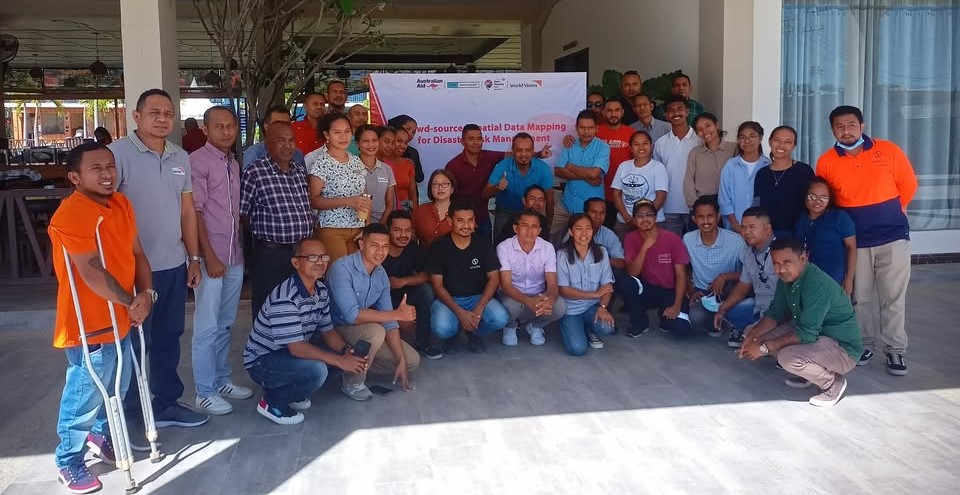
A major turning point came in 2022, when the OpenStreetMap initiative was formally started through a collaboration between World Vision Timor-Leste and the Open Mapping Hub Asia-Pacific (OMH-AP) under the Disaster READY project. This initiative aimed to improve disaster preparedness and response by promoting the use of open geospatial data.
As part of the project, World Vision Timor-Leste provided opportunities for young people interested in mapping and GIS to gain practical skills and participate in mapping activities. Among those selected was Ponciano da Costa de Jesus, now the President of the G-SIG, who attended specialized training facilitated by OMH-AP in Dili in August 2022.
This training inspired the formation of G-SIG’s vision to promote and expand the use of OpenStreetMap across the country. Since then, G-SIG has been actively leading efforts to build local mapping capacity, engage youth, and support humanitarian and environmental initiatives using the OSM platform in Timor-Leste.
The Impact of OpenStreetMap in Timor-Leste
Since 2022, G-SIG has established strong partnerships with World Vision Timor-Leste, the Open Mapping Hub Asia-Pacific (OMH-AP), OSGeo Oceania, and the Humanitarian OpenStreetMap Team (HOT) to further develop and expand the use of the OpenStreetMap (OSM) platform. These collaborations have significantly contributed to improving the availability and quality of geospatial data in Timor-Leste.
As a result of these efforts, in 2023, G-SIG officially launched the Community OpenStreetMap Timor-Leste, a volunteer-based group dedicated to using OSM for mapping and updating geospatial information across the country. This community has played a crucial role in supporting disaster preparedness, development planning, and environmental monitoring. More information and updates about this initiative can be found on the OpenStreetMap Timor-Leste Facebook page.
Through G-SIG, we have also collaborated with several international organizations in Timor-Leste, including PLAN International, OXFAM, ADRA, Red Cross Timor-Leste (CVTL), and the International Federation of Red Cross and Red Crescent Societies (IFRC). These partnerships have focused on using OpenStreetMap for disaster mapping and preparedness. Notable projects supported by OSM include:
In addition to international collaborations, G-SIG has also built meaningful partnerships with local organizations. Since 2023, we have been working closely with Feto Enginera, a local NGO focused on women's empowerment and disaster resilience in small island states. This collaboration involved using OpenStreetMap to map flood-prone areas in Dili, with a focus on vulnerable women and communities.
We are also actively partnering with academic institutions, particularly the National University of Timor-Lorosa’e (UNTL), to integrate OpenStreetMap into academic activities, research, and student training programs. These efforts aim to strengthen local capacity and promote the use of open geospatial data in higher education and scientific research in Timor-Leste.
Transforming Data into Digital Mapping with the Community
In Timor-Leste, disaster-prone areas have traditionally been represented using manual or hand-drawn maps. While these methods have served their purpose in the past, they often lack accuracy, are difficult to update, and can be challenging for communities to interpret or access. With the introduction and growing presence of OpenStreetMap (OSM) in Timor-Leste, G-SIG has been working to transform traditional mapping practices into community-led digital mapping.

In 2024, G-SIG collaborated with the community of Kaikoli Village in Dili to introduce digital maps and build local capacity. Community members were trained on how to read digital maps, identify local resources, and validate disaster-prone areas using their own knowledge and experience. This participatory mapping approach fostered a strong sense of ownership and improved local engagement with disaster preparedness information.
In the Bobonaro Municipality, as part of the Disaster READY project, G-SIG worked alongside World Vision Timor-Leste to bring digital mapping tools to rural communities. These initiatives empowered local residents to understand and interact with digital maps, helping them identify key resources, hazards, and vulnerable areas in their villages. This process ensured that the maps reflected both technical data and local wisdom.
Similarly, in Oecusse, G-SIG partnered with OXFAM Timor-Leste to carry out community-based digital mapping activities. By involving local participants in mapping flood-prone areas, the project has enhanced early warning efforts and supported the development of community disaster action plans. These experiences demonstrate that communities in both urban and rural areas of Timor-Leste are capable of understanding and utilizing digital maps when they are introduced in a participatory, inclusive way. The use of OpenStreetMap not only improves access to accurate and up-to-date spatial information but also strengthens community resilience and preparedness in the face of climate-related disasters.
Whether you are a student, a community member, or a humanitarian worker, you can contribute to OpenStreetMap and help make Timor-Leste more resilient. By mapping our country together, we strengthen our ability to adapt, prepare, and respond to disasters.


Congratulations for this, you have done a great things
Am from Tanzania in Africa but from the bottom of my heart I would to congratulate G-SIG leaders and Members